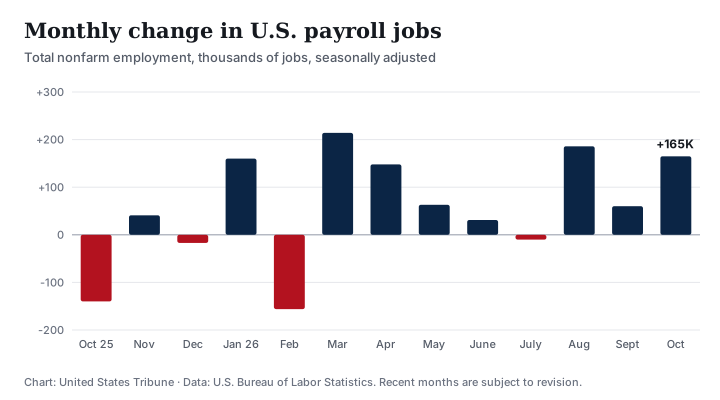
U.S. employers added 165,000 jobs in October, and the unemployment rate changed little at 4.1%, the Bureau of Labor Statistics reported on Friday. The gain in nonfarm payroll employment, which counts jobs outside agriculture, exceeded the bureau’s figure of 48,000 jobs added per month, on average, over the prior 12 months.
The bureau said jobs increased in professional and business services, health care, and transportation and warehousing. Professional and business services added 70,000 jobs, well above its average monthly gain of 15,000 over the prior 12 months. Health care added 42,000 jobs, with 16,000 in hospitals, 11,000 in home health care services and 5,000 in outpatient care centers.
Transportation and warehousing added 25,000 jobs, with couriers and messengers accounting for 17,000 of them. Manufacturing employment rose by 19,000, and the bureau said it has increased by 101,000 since a recent low in December 2025. Employment showed little change in other major industries, including construction, retail trade, financial activities, leisure and hospitality, and government.
In the household survey, the number of unemployed people was 7.1 million. The bureau said the unemployment rate has stayed between 4.1% and 4.3% since March. The labor force participation rate was 61.9% and the employment-population ratio was 59.3%, both little changed.
The number of people working part time for economic reasons rose by 339,000 to 4.8 million. These are people who wanted full-time work but had their hours cut or could not find full-time jobs. About 2.0 million people were long-term unemployed, meaning jobless for 27 weeks or more. They made up 27.6% of all unemployed people.
Average hourly earnings for all private-sector employees rose 14 cents, or 0.4%, to $38.00 in October. Over the past 12 months, they have risen 3.1%. The average private-sector workweek stayed at 34.4 hours.
The bureau also revised earlier months. August job growth was raised from 133,000 to 186,000, and September was raised from 29,000 to 60,000. The bureau said employment in those two months combined is 84,000 higher than previously reported. It said such revisions come from added reports from businesses and government agencies and from recalculated seasonal factors.
The bureau’s release notes that a monthly change of about 122,000 in payroll employment is statistically significant in the establishment survey, which counts jobs on employer payrolls. The household survey, which measures unemployment, has a threshold of about 650,000. The release also notes that household data for October 2025 were not collected because of the federal government shutdown.
The bureau scheduled the November 2026 employment report for Friday, Dec. 4, 2026, at 8:30 a.m. Eastern time.