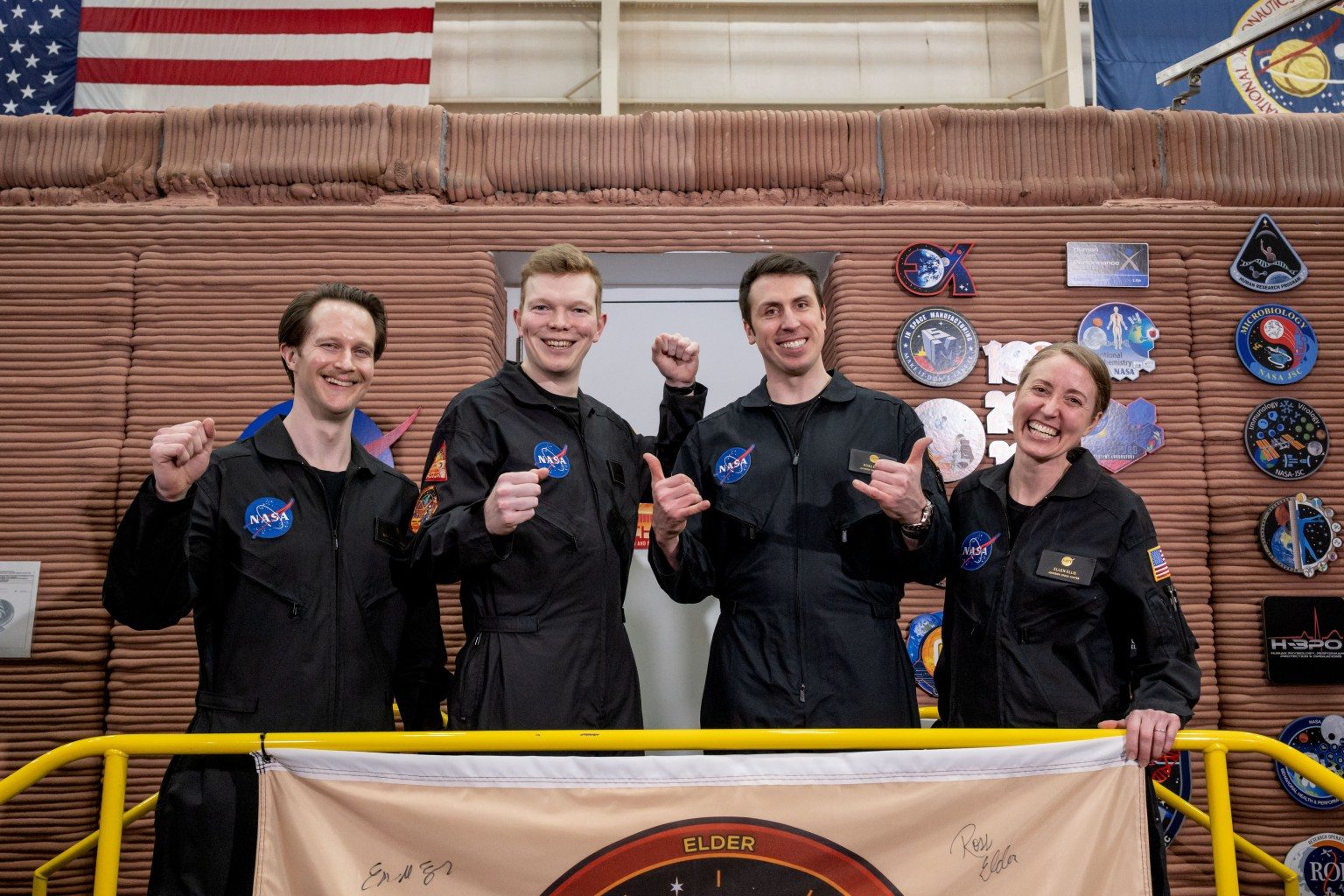
Four research volunteers who lived 378 days inside a windowless Mars habitat stepped outside on Oct. 31, ending NASA’s second yearlong surface simulation.
Ross Elder, Ellen Ellis, James Spicer and Matthew Montgomery left the Mars Dune Alpha habitat at NASA’s Johnson Space Center in Houston. They had entered the roughly 1,700-square-foot, 3D-printed structure on Oct. 19, 2025, for the Crew Health and Performance Exploration Analog, known as CHAPEA, Mission 2.
The study is meant to show how a crew stays healthy and effective when supplies are tight and radio contact with Earth can lag by as much as 22 minutes in each direction, according to NASA. The crew took part in simulated Marswalks, robotic work, habitat upkeep, exercise and crop growing.
Johnson Space Center Director Vanessa Wyche said the mission is about preparing for human exploration beyond Earth and collecting knowledge needed to protect crew health and performance. NASA astronaut Jack Hathaway told the crew their isolation demanded physical and mental strength, teamwork and grit. According to NASA, Hathaway finished a 237-day stay aboard the space station and came home while the analog crew was still inside.
In that same stretch, NASA said, the Artemis II astronauts flew around the Moon and set the record for the greatest distance humans have gone from Earth. The agency also marked 25 years of uninterrupted human presence on the International Space Station on Nov. 2, 2025.
Elder, the commander, is a U.S. Air Force experimental test pilot. From inside the habitat, the crew flew a drone and a rover by remote control to survey ground and find or gather rock samples. He said long walks in spacesuits, airlock steps and suit preparation took stamina, and he treated food, exercise and rest as essential.
Ellis, the medical officer, is a U.S. Space Force officer who has worked at the National Reconnaissance Office. She helped arrange biological sample collections and health-research supplies. “When I look back on the mission, the most salient point I’ve learned is that a future Mars crew requires a highly integrated ground team,” Ellis said.
Spicer, the flight engineer, has a background in satellite communications and spacecraft development. He compared the year to life on a submarine or boat, where limited space and supplies shaped daily choices. The crew tracked items from dish soap to respirator filters and managed food and water carefully. He said a break from constant news and social media helped him focus, and that the data should inform planning for later Mars crews and their safety, health, performance and comfort.
Montgomery, the science officer, has worked in hardware engineering, robotics, technology startups and independent films. He helped identify rock samples, set up the habitat’s 3D printing and ran a seed-germination test that used a control and simulated Martian soil. He said speaking up when something seemed off helped catch problems with equipment, safety and data quality.
Researchers will spend two weeks on evaluations and debriefs to read the crew’s data next to their accounts, NASA said. The work follows the first CHAPEA mission, which ended July 6, 2024.
Grace Douglas, the principal investigator, said the research will help NASA balance health and performance risks against resources such as crew time, communication capacity, and designs for food and water systems. She also said many resource problems that space crews face resemble problems on Earth.
Sara Whiting, the project scientist, said the findings arrive while NASA is deciding how crews will stay and work at the Moon Base, which the agency called the first human outpost on the lunar surface, near the south pole. “This is really the now moment for this kind of data,” Whiting said.