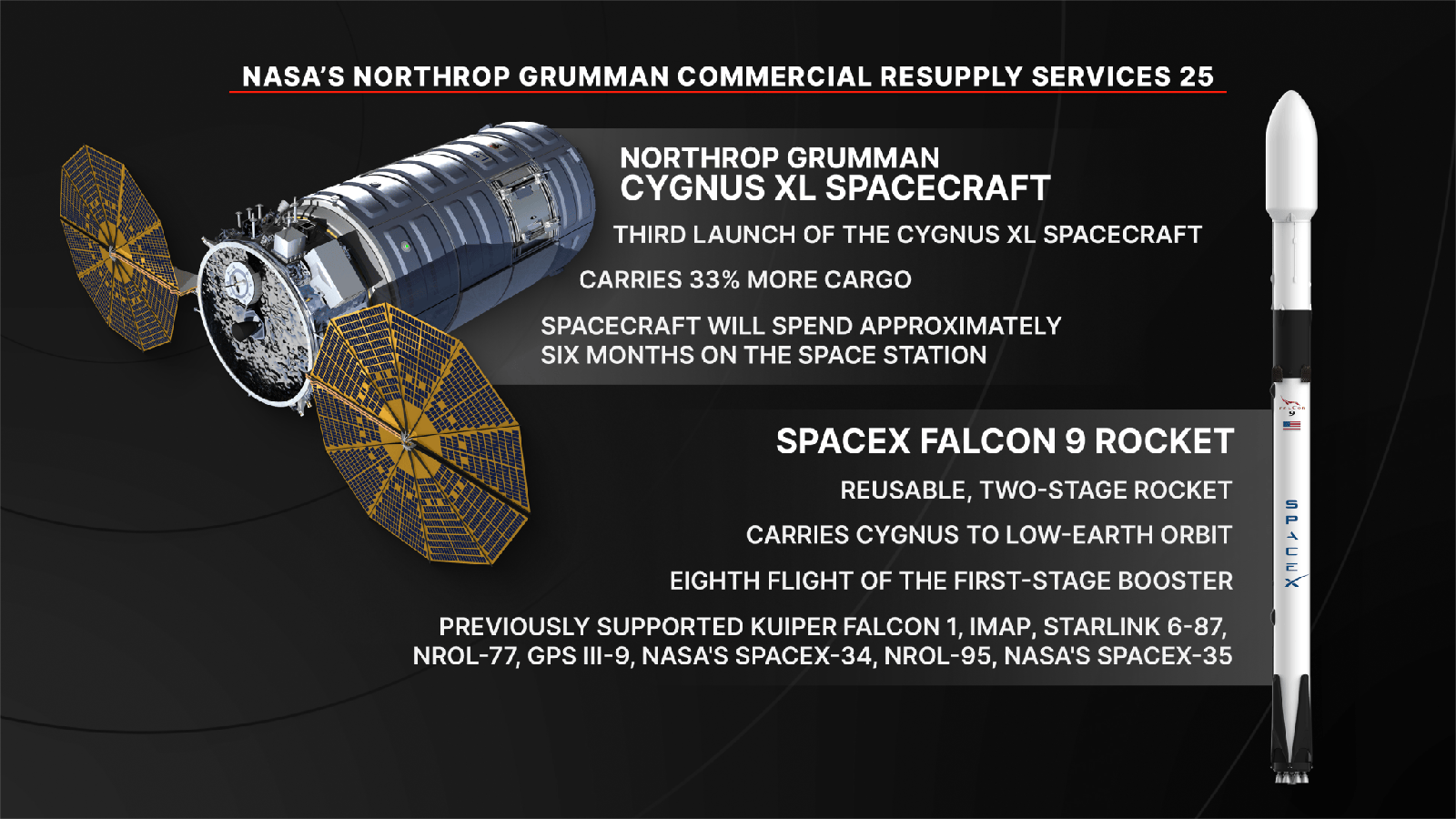
NASA outlined the science and equipment flying on Northrop Grumman’s Commercial Resupply Services 25 mission, saying the Cygnus cargo ship will bring about 11,000 pounds of research and supplies to the International Space Station. The overview was released Nov. 24, 2026.
The agency said this will be the third flight of the company’s Cygnus XL, the larger version of its solar‑powered cargo spacecraft. According to NASA, Cygnus XL will launch on a SpaceX Falcon 9 from Cape Canaveral Space Force Station in Florida. NASA did not state a launch date.
After arrival, astronauts will use the Canadarm2 to grapple the spacecraft before ground controllers install it to the Unity module’s Earth‑facing port for unloading, NASA said. The spacecraft is named in honor of NASA astronaut James “Jim” A. Lovell Jr. NASA said astronauts Jessica Watkins and Luke Delaney will be on duty during the approach, with Watkins at the arm controls and Delaney monitoring the arrival.
NASA said the payload includes work aimed at improving drug delivery for cancer and osteoarthritis treatment, predicting cancer spread, advancing treatments for muscle loss, improving radiation sensing, and supporting food production for future long‑duration missions. Cardinal Muscle 2.0 uses a muscle tissue model in microgravity to test whether Food and Drug Administration‑approved drugs used for other conditions can be repurposed to prevent or reduce muscle loss.
The DNA Nano B investigation uses microgravity to manufacture tiny DNA‑inspired particles designed to deliver medicine into dense tissues, such as cartilage and solid tumors. NASA said microgravity may enable more uniform particle assembly, helping researchers refine production methods.
The Active Radiation Environment Sensor, or ARES, will test a small radiation monitoring device designed to integrate with spacecraft systems and provide real‑time readings inside crew living areas. NASA said results could inform radiation monitoring strategies and crew safety measures for future exploration missions.
Encapsulate‑1 grows miniature replicas of patients’ tumors to study how cancer cells move and interact in microgravity. According to NASA, researchers aim to develop a space‑based diagnostic tool that could predict cancer progression months or years in advance.
Ohalo III is a plant growth facility designed to help food crop production on future long‑duration missions. NASA described it as mostly automated and said it uses innovative water recovery and air exchange technologies to grow a variety of crops.
NASA also described the JOining demonstrations IN‑Space, or JOINS, technology activity inside the Bishop Airlock. The agency said JOINS will perform autonomous robotic welding in space and will test two approaches: laser beam welding, which uses a high‑precision laser to melt and fuse materials together, and friction stir welding, which uses a rotating tool to stir the metals together, with friction generating enough heat to soften the materials. NASA said JOINS will perform these welding approaches on aluminum and stainless steel. According to NASA, in‑space joining could enable large structures to be assembled and integrated after launch and may be needed to build and repair large infrastructure, such as structures that will support future exploration under Moon Base.
Other supplies listed by NASA include crew quarter blankets and covers, hatch seal covers for the U.S. segment, a modified toilet pretreat hose for the Universal Waste Management System, Alpha Magnetic Spectrometer spacewalk tools, and batteries for an Anomaly Gas Analyzer.