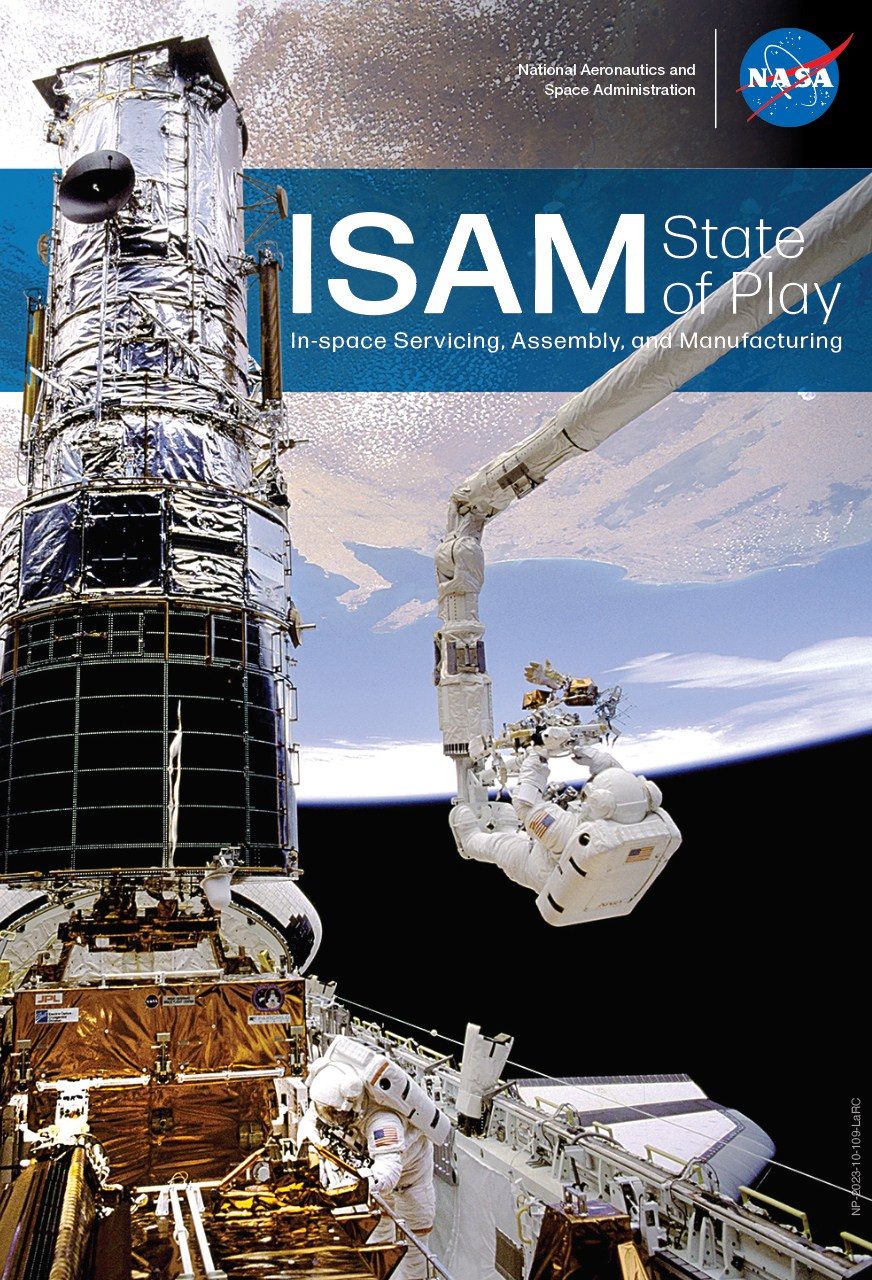
NASA released the 2026 edition of its In-Space Servicing, Assembly, and Manufacturing State of Play, a 368-page survey of current capabilities and developers. The agency said the document has become an industry reference as the field grows.
Published since 2021, the report catalogs technologies across 11 functional areas, from robotic manipulation to refueling and structural assembly, according to NASA. The agency said it serves as both an encyclopedia and a roadmap for spacecraft that can be serviced, assembled, and manufactured in orbit rather than launched as single integrated systems.
The team set strict entry criteria. Hardware must physically exist as a ground prototype or an in-flight demonstration to be included. Concepts submitted as presentation slides do not qualify until a later review, NASA said.
Dale Arney, senior team lead for the ISAM Technology Portfolio at NASA’s Langley Research Center, said interest has grown as companies look for competitive context. Some unnamed companies asked whether the team held proprietary information; Arney said it does not. He added that what began as an internal reference has become “the industry’s go-to resource for understanding what’s possible versus what’s still conceptual.”
NASA said this rigor matters because ISAM capabilities are expected to support missions that cannot be done with single-launch approaches. The report cites future needs such as telescopes larger than any launch vehicle fairing, persistent national security assets that are mobile and resilient, and commercial systems that can upgrade on orbit without full replacement.
The report is built collaboratively. Team member John Mulvaney described it as “kind of a crowdsource document.” NASA said each year brings more interviews with industry partners to ensure accuracy and completeness. Contributors include NASA centers such as Ames, Glenn, Marshall, Kennedy, and Johnson, along with international developers that meet the hardware criteria.
The 2026 edition adds developer profiles and facilities documentation to show who is building what and where, NASA said. The agency said the result gives mission designers both a shared vocabulary and a baseline of current capability, along with context for collaboration opportunities.
NASA said the 2026 ISAM State of Play is available for download at NASA.gov.