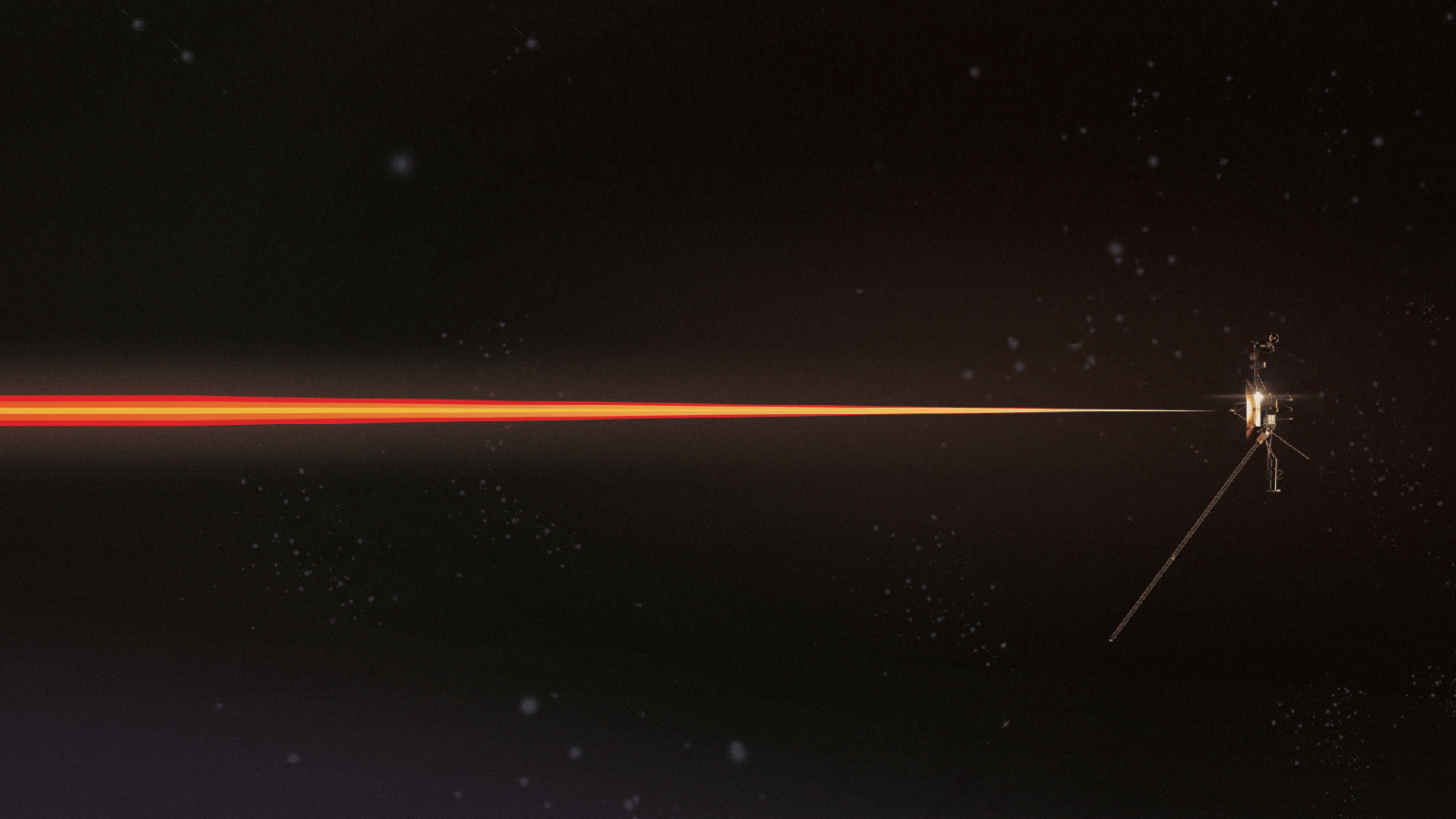
NASA said its Voyager 1 spacecraft reached a distance of one light-day from Earth on Nov. 18, after more than 49 years of travel. The agency said the probe is the farthest-flying spacecraft built by humans.
A light-day is the distance light travels in 24 hours, about 16.1 billion miles, according to NASA. The spacecraft crossed the mark at 2:16 a.m. PST (5:16 a.m. EST). Team members at NASA’s Jet Propulsion Laboratory in Southern California heard from the probe 24 hours later, early Thursday, which is how long its radio signal takes to reach Earth.
NASA said no science or engineering data has come in from Voyager 1 since Nov. 14. Voyager 1 is still transmitting a carrier signal, which normally carries that data. Engineers used the carrier signal and trajectory calculations to confirm the milestone, and they are still analyzing the problem with the data. The release did not say what is causing the problem or when data might resume.
NASA gave some context for the distance. Sunlight needs about four hours to get to Neptune, then roughly 20 more hours to arrive at Voyager 1, the agency said. It also said a light-year is 5.88 trillion miles.
Voyager 1 and its twin, Voyager 2, launched in 1977. NASA said they are the only probes in interstellar space, the region outside the heliosphere. The heliosphere is a bubble formed by particles and magnetic fields from the Sun, and it turns away cosmic radiation. Voyager 1, traveling about 38,000 mph, left the heliosphere in 2012. Voyager 2 took a different path and crossed the boundary in 2018.
According to the agency, the two Voyagers ranked third and fourth among spacecraft to reach Jupiter and Saturn, and were the first to send back detailed, high-resolution images of those planets and their moons. Voyager 2 went on to examine Uranus and Neptune, two ice giants. Both probes are still measuring shifts in the Sun’s magnetic field.
Linda Spilker, Voyager project scientist at JPL, said one surprise has been how far the Sun’s effect extends into interstellar space, all the way out to Voyager 1. She said the probes may last long enough to show where that influence ends.
Aging hardware has posed challenges, NASA said, including clogged thrusters and a malfunctioning computer. Earlier this year, engineers turned off three devices on Voyager 1 and replaced them with three lower-power alternatives. NASA described the move as carrying some risk. The change is meant to get more use from the spacecraft’s 50-year-old radioisotope thermal generator, which turns heat from decaying plutonium into electricity.
According to NASA, each Voyager loses about 4 watts of power a year as the plutonium runs down. The agency said the latest energy-saving step is expected to keep the current science instruments on both probes running until at least their 50th launch anniversaries next summer.
NASA’s Deep Space Network, a set of large antennas at three sites around the world, handles communication with the probes. Suzanne Dodd, Voyager project manager at JPL, said the team listens to Voyager 1 every day and sends commands weekly. She said a signal now needs a full day to get to the spacecraft and another day to come back. She added that once it can no longer communicate with Earth, Voyager 1 will become “humanity’s silent ambassador to the stars.”