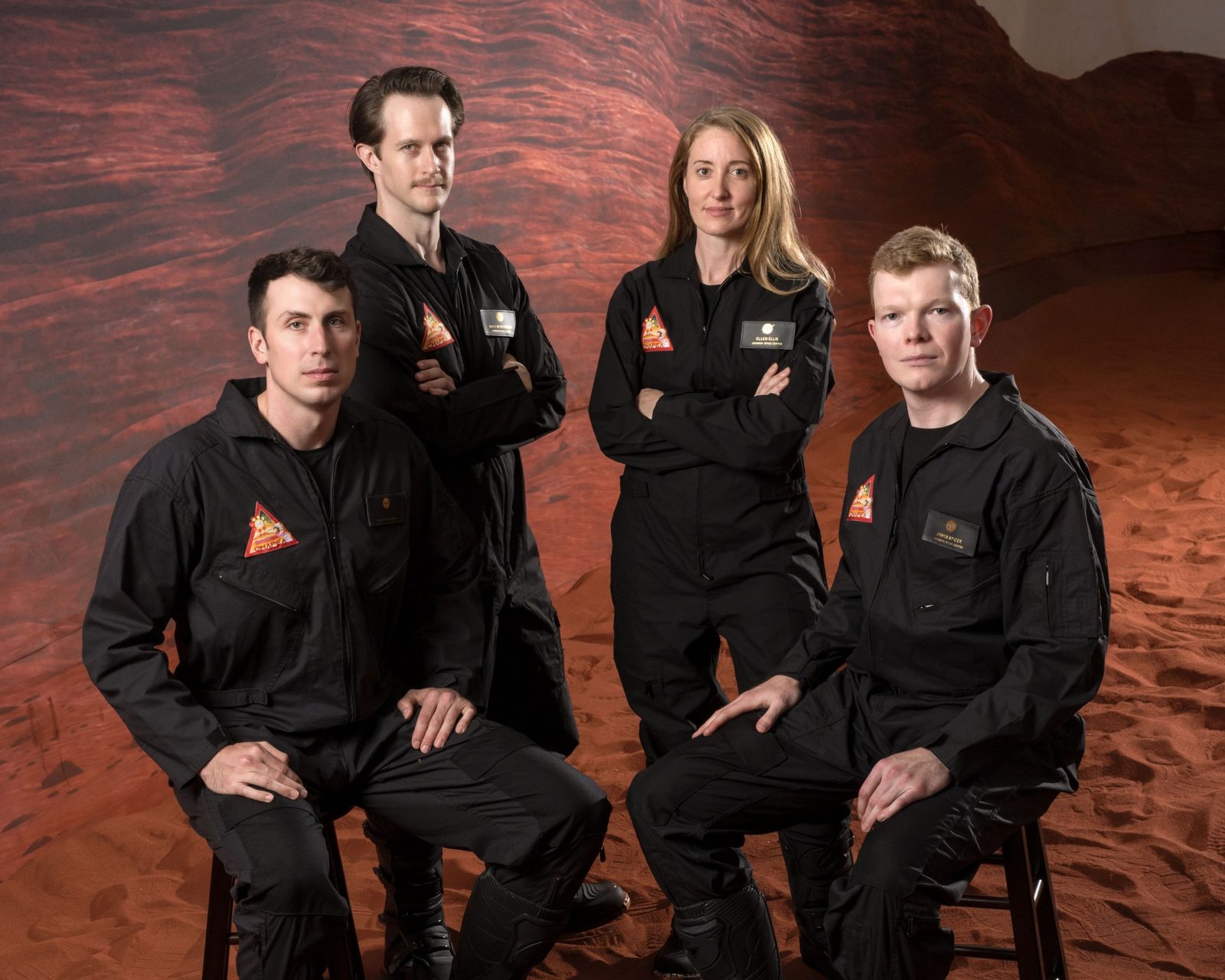
NASA on Tuesday invited media to cover the end of a yearlong simulated Mars mission and said it will provide live coverage when the four volunteers exit their habitat on Saturday, Oct. 31. The volunteers will leave after 378 days of isolation inside a facility at the agency’s Johnson Space Center in Houston, according to NASA.
NASA said coverage will begin at 3 p.m. EDT and will stream on NASA Johnson’s YouTube and social media accounts. Johnson Center Director Vanessa Wyche and NASA astronaut Jack Hathaway will provide remarks. The crew members — Ross Elder, Ellen Ellis, James Spicer, and Matthew Montgomery — also will speak.
The agency said the health and performance data from the simulation can help develop methods to counter human spaceflight risks for future Artemis and Moon Base missions. NASA added that data from the mission can aid preparation for lunar missions by optimizing food system design, efficient use of crew time, bandwidth on the Deep Space Network, and other aspects of living in deep space. It said the data also can help flight doctors and psychologists strengthen spaceflight medical care and behavioral support practices to ensure crew readiness and performance.
Media are invited to watch the CHAPEA Mission 2 exit ceremony live at NASA Johnson on a screen outside the hangar that holds the Crew Health and Performance Exploration Analog (CHAPEA, pronounced cha-pea-ah) facility. A subject matter expert will be available in person to answer questions after the ceremony. NASA said media will have the chance to capture the crew stepping outside for the first time in more than a year.
U.S. media interested in attending in person, or in speaking virtually with the crew in the days after completion of the mission, must contact the NASA Johnson newsroom at jsc-newsroom@mail.nasa.gov no later than 2 p.m., Friday, Oct. 30, according to NASA.
The second CHAPEA mission began on Oct. 19, 2025. NASA said the four crew members lived and worked inside a 3D-printed, 1,700-square-foot habitat that simulated Mars mission operations. Their tasks included conducting simulated spacewalks, exercising, performing habitat maintenance, and growing plants, while operating under stressors such as communication delays, resource limitations, and isolation.