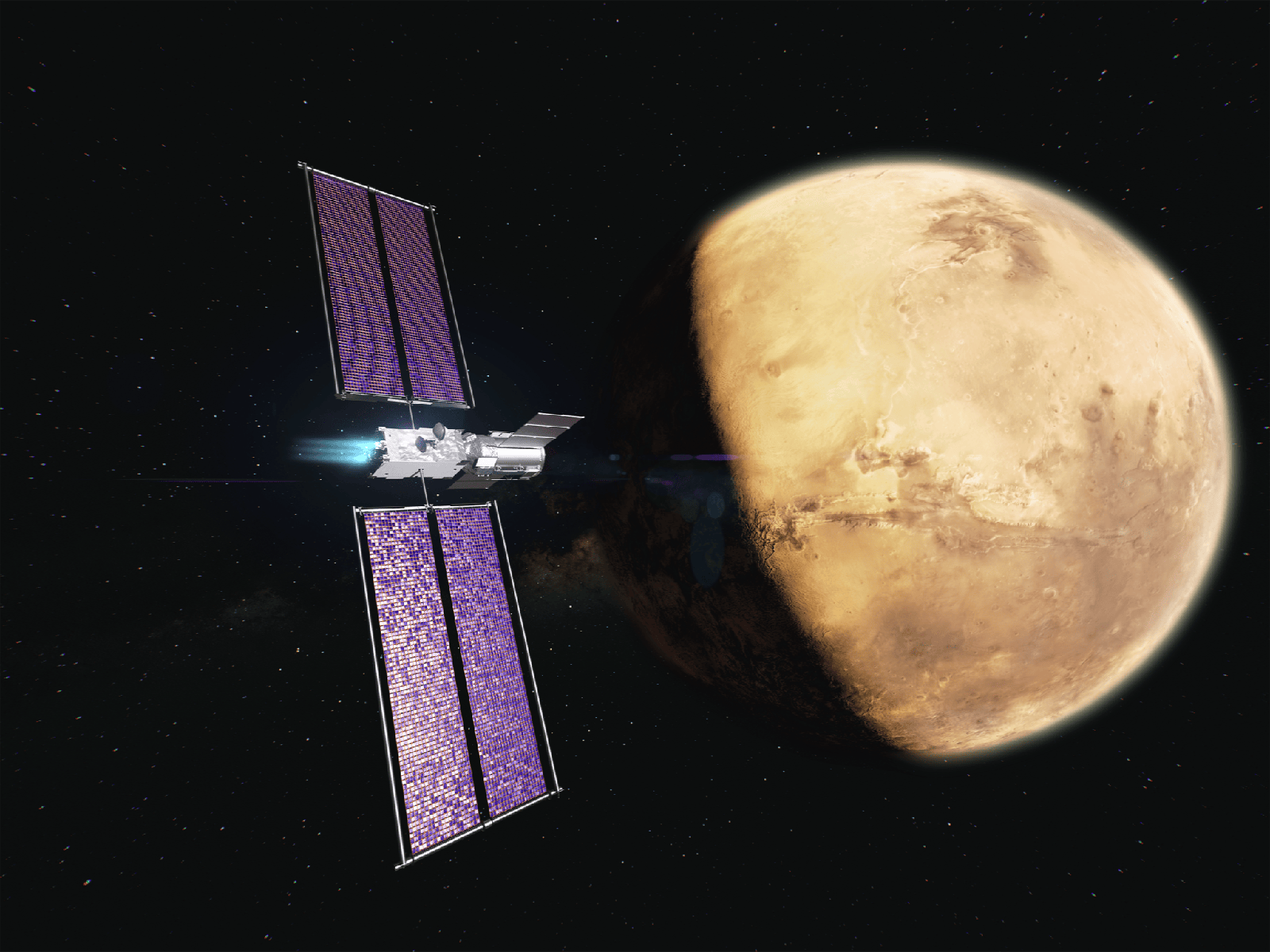
NASA completed a major review for its Space Reactor-1 (SR-1) Freedom mission and locked in key parts of the spacecraft, the agency said. The review, held in October at NASA’s Glenn Research Center in Cleveland with experts from the U.S. Department of Energy and industry, moved the project from concept toward a defined design, according to NASA. The mission is targeted to launch in 2028 and, for the first time, demonstrate nuclear electric propulsion in deep space, the agency said.
SR-1 will use both nuclear and solar power to send SkyFall, a capsule with three next-generation helicopters, to Mars. NASA said the helicopters will study Martian geology and climate history, explore new terrain, and search for signs of subsurface ice.
NASA said SR-1 will demonstrate how fission power can enable long-duration missions, pave the way for reliable surface power systems to support NASA’s future Moon Base, and enable exploration deeper into the solar system. “SR-1 marks a pivotal step in how we travel through the solar system,” said Steve Sinacore, SR-1 Freedom program director.
The agency said several design decisions are set. SR-1 will use a shorter boom than shown in early illustrations to cut weight, ease assembly, and simplify the spacecraft. NASA and DOE experts determined that improved shielding and spacecraft design allow the reactor to operate closer to the Power and Propulsion Element while maintaining radiation protection for electronics and the SkyFall payload.
Teams are still assessing the number of radiator panels, the nuclear module’s output power, and how long the reactor will operate, NASA said. The Power and Propulsion Element’s communications will be updated with larger X-band antenna dishes for the journey to Mars. NASA said further maturation of the plans will focus on reducing risk, simplifying the design, and staying on schedule.
NASA awarded a $39.3 million contract to Johns Hopkins University’s Applied Physics Laboratory to develop the heat rejection system for the spacecraft’s nuclear power module. The agency said the system will remove excess heat so the nuclear power system can operate safely and efficiently. The lab is working with Advanced Cooling Technologies as a strategic commercial partner for heat pipe and composite radiator technologies. Awarded under the Aerospace Research, Development, and Engineering Support II contract, the action ensures the team will design, build, test, and evaluate the system and produce the flight hardware, NASA said.
NASA outlined an updated mission profile. After launch and once the spacecraft has left Earth orbit, SR-1 Freedom will activate and gradually increase reactor power for an initial operating period before shutting down. During this period, the spacecraft will collect and send performance data to Earth, then cruise to Mars on solar power. After delivering SkyFall to Martian orbit, SR-1 Freedom will restart its fission reactor and collect additional performance data in deep space, according to the agency.
With key design decisions advancing and teams across NASA, DOE, and industry working together, SR-1 Freedom is moving toward its 2028 launch goal, NASA said. “What we learn from SR-1 Freedom will shape the future of exploration for decades to come,” Sinacore said.