The Supreme Court of the United States was established in 1789 and met in temporary locations for nearly a century and a half before moving into its own dedicated building. The U.S. Senate Committee on the Judiciary, the U.S. House of Representatives Office of the Historian and the Federal Judicial Center detail the court’s history and its physical relocations.
A history of the Supreme Court and its building
Last checked against its official sources on Nov. 14, 2026. Explainers are re-checked regularly.
- Sept. 24, 1789President George Washington signs the Judiciary Act of 1789, establishing the Supreme Court.
- Oct. 19, 1789John Jay takes the oath as the first chief justice.
- Feb. 1, 1790The Supreme Court calls its first assembly in the Merchants Exchange Building in New York City.
- 1800The Supreme Court relocates to the District of Columbia and uses a room in the U.S. Capitol.
- August 1814British troops set fire to the U.S. Capitol, forcing the court to temporarily vacate.
- 1860The court moves to a larger, two-story chamber on the first floor of the U.S. Capitol.
- 1891Congress passes the Judiciary Act of 1891, which abolishes the requirement for justices to ride the circuit.
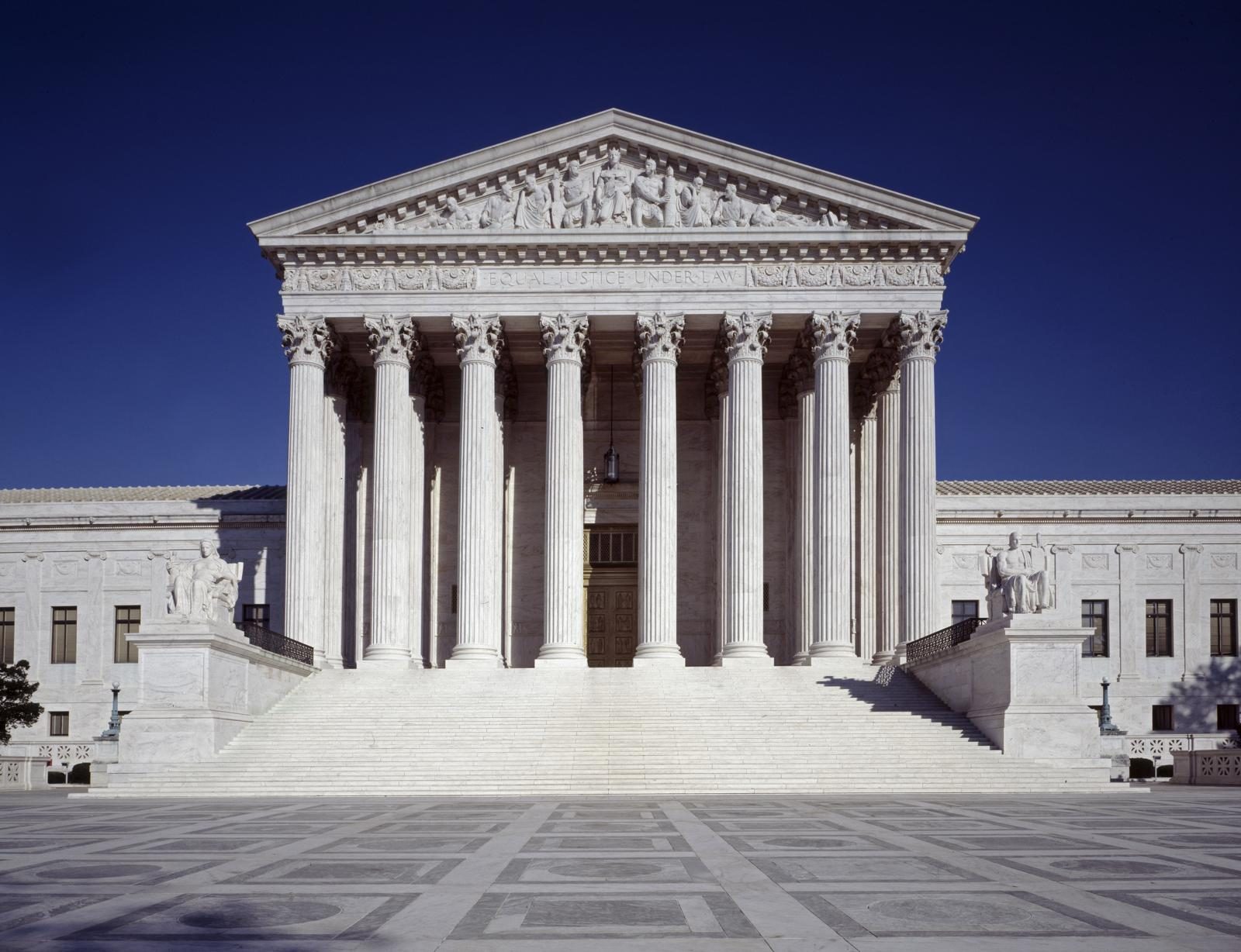
- 1935Construction of the dedicated Supreme Court building is completed.
- December 2022Congress passes a law ordering the removal of Chief Justice Roger Taney's bust from the Old Supreme Court Chamber.
Dates and events as stated in the official sources listed below, through 2022.
The establishment of the court
Article III, Section 1 of the Constitution mandated the creation of a supreme court, according to the U.S. Senate Committee on the Judiciary. Congress fulfilled this requirement by passing the Judiciary Act of 1789. President George Washington signed the act into law on Sept. 24, 1789, the U.S. House of Representatives Office of the Historian states.
The legislation created a Supreme Court with one chief justice and five associate justices, the U.S. Senate Committee on the Judiciary notes. Washington nominated John Jay of New York as the first chief justice. Jay took the oath of office on Oct. 19, 1789.
The Judiciary Act also required justices to travel twice a year to preside over lower circuit courts throughout the country, a practice known as riding the circuit, the U.S. Senate Committee on the Judiciary says. Congress reduced this requirement to one trip per year in 1793 and abolished it completely in 1891.
Early meeting places
The Judiciary Act of 1789 dictated that the court hold two sessions each year at the seat of government, according to the Federal Judicial Center. The court first assembled in February 1790 at the Merchants Exchange building in New York City. The sessions were brief, with the justices primarily handling administrative tasks.
Congress passed the Residence Act in 1790, which temporarily relocated the national capital to Philadelphia, the Federal Judicial Center states. The court held a two-day term in Independence Hall in February 1791. It later conducted most of its business in City Hall for the remainder of the decade.
Relocation to the Capitol
The federal government moved to the District of Columbia in 1800, but Congress made no provision for the court’s accommodation, the Federal Judicial Center says. Congress eventually allowed the court to use a room on the lower floor of the partially completed U.S. Capitol. The court remained in the Capitol for the next 134 years.
The court vacated the building in August 1814 after British troops set it on fire, meeting in a local tavern and a different Capitol room before returning to a restored chamber in February 1819, according to the Federal Judicial Center. This restored room is now known as the Old Supreme Court Chamber. The court moved to a larger chamber on the first floor of the Capitol in 1860.
A permanent building
In the early 20th century, Chief Justice William Howard Taft lobbied lawmakers for a separate building, arguing that the court lacked adequate facilities and office space, the Federal Judicial Center states. Congress authorized the creation of the Supreme Court Building Commission in 1928 to procure plans for a dedicated building.
Architect Cass Gilbert designed the building in a neoclassical revival style with marble steps and a grand portico, according to the Federal Judicial Center. Congress approved the plans in 1929 and appropriated $9,740,000 for the project.
Construction on the building began in 1932 and was completed in 1935, the Federal Judicial Center says. To date, 112 justices have served on the Supreme Court, according to the U.S. Senate Committee on the Judiciary.
Latest Tribune coverage
Sources
- Supreme Court meeting places — Federal Judicial Center
- The establishment of the Supreme Court — U.S. House of Representatives, Office of the Historian
- Supreme Court nominations: history — U.S. Senate Committee on the Judiciary
How this article was made
- Written with
- Gemini 3.1 Pro (Google)
- Fact-checked by
- GPT-5 (OpenAI) — passed
- Generated
- Nov. 14, 2026, 5:09 a.m. ET
- Sources used
- 3 official sources, listed above
- Last checked
- Nov. 14, 2026, against the official sources above
- Article type
- Explainer
The AI wrote only from the sources listed. No human reporter was involved. Read our standards or compare the models in the AI Report Card.