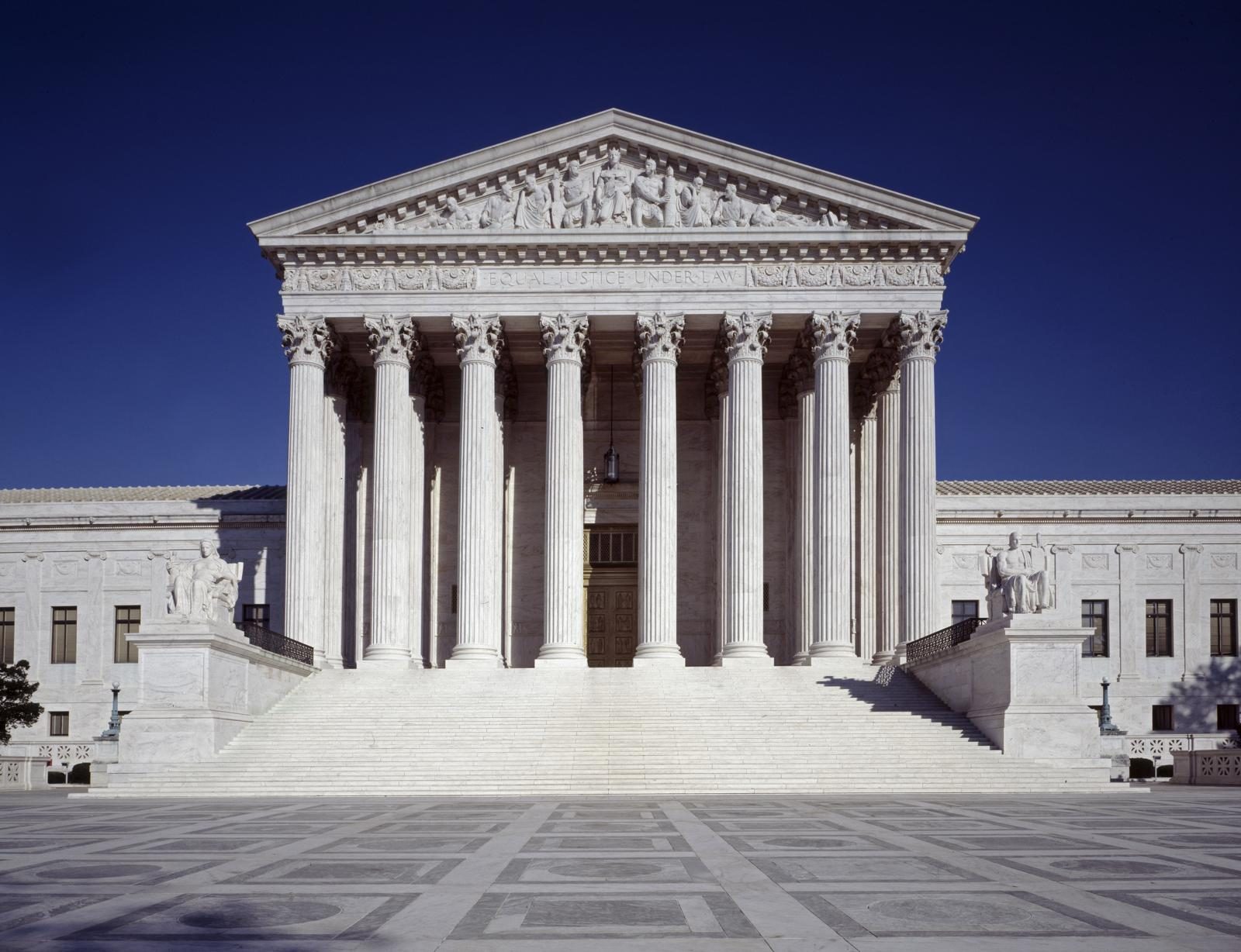
A case reaches the Supreme Court of the United States in one of two ways. A few types of disputes start there, but most arrive on appeal after a lower court has ruled. Understanding the steps helps explain why the Court takes so few cases and how its decisions are made.
Two kinds of jurisdiction
Jurisdiction is a court’s authority to hear a case. According to the Administrative Office of the U.S. Courts, the Constitution gives the Supreme Court both original and appellate jurisdiction.
Original jurisdiction means the Court is the first, and only, court to hear a case. The Constitution limits these cases to disputes between states and disputes involving ambassadors and other high-ranking ministers. Appellate jurisdiction means the Court can review the decisions of lower courts. Most of the cases the Court hears are appeals.
Asking the Court to take a case
A party that is not satisfied with a lower court’s decision must petition the Supreme Court to hear the case. The main way to do this is to ask the Court to grant a writ of certiorari. This is a request that the Court order a lower court to send up the record of the case for review.
The Court usually has no obligation to take these cases. The Administrative Office of the U.S. Courts says it usually does so only if the case could have national significance, might harmonize conflicting decisions in the federal circuit courts, or could have precedential value. A precedent is an earlier decision that guides later ones. Cases typically come from a U.S. Court of Appeals or from a state’s highest court, if that court decided a constitutional issue.
The agency says the Court accepts 100 to 150 of the more than 7,000 cases it is asked to review each year. Under the Court’s own rules, four of the nine Justices must vote to accept a case. Five must vote to grant a stay, which is an order that pauses something, such as an execution. In some instances, one Justice may grant a stay until the full Court can review it.
Each Justice may have three or four law clerks per term. Law clerks are recent law school graduates who help with legal research and with drafting opinions. Many Justices take part in what is informally called the cert pool, in which incoming petitions are divided among the participating Justices each week. Their clerks read the petitions, write short memos and recommend whether to accept each case.
Briefs and oral arguments
When the Justices grant a petition, the case is placed on the Court’s docket, its list of cases. The petitioner, the party that brought the appeal, then writes a brief of no more than 50 pages. A brief is a written statement of a party’s legal case. The other side, called the respondent, then files its own brief of no more than 50 pages. Both sides may later file shorter briefs answering each other.
Others may also file briefs. The U.S. Government, through the Solicitor General, can file one if it is not directly involved in the case. With the Court’s permission, groups with no direct stake in the outcome may file an amicus curiae brief. The Latin term means “friend of the court.”
By law, the Court’s term begins on the first Monday in October and runs through the Sunday before the first Monday in October of the next year. The Court typically recesses from late June or early July until October. Oral arguments are heard from October through April. They take place in the first two weeks of each month from October through December, and in the last two weeks of each month from January through April. Arguments are heard on Mondays, Tuesdays and Wednesdays unless the Court directs otherwise.
Oral arguments are open to the public. Typically, two cases are heard each day, starting at 10 a.m., with an hour set aside for each. Each side has about 30 minutes, though lawyers do not have to use all of it. The petitioner argues first and may reserve time for rebuttal, which means speaking last. Most of the time is spent answering the Justices’ questions.
Conference, votes and opinions
The Justices decide cases at a private meeting called the Justices’ Conference. While the Court is in session, conferences are scheduled on Wednesday and Friday afternoons. The Wednesday conference covers cases heard on Monday, and the Friday conference covers cases heard on Tuesday and Wednesday. Only the Justices are allowed in the room. At each conference, the first item is typically the week’s petitions for certiorari.
On each case, the Chief Justice speaks first, and then each Justice speaks in descending order of seniority. Votes are cast in the same order. The Chief Justice, or the most senior Justice in the majority if the Chief Justice is in the minority, assigns a Justice in the majority to write the opinion of the Court. The most senior Justice in the minority can assign the dissenting opinion. A Justice who agrees with the outcome but not the reasoning may write a concurring opinion. When the vote is tied, the lower court’s decision stands. This can happen if a seat is vacant or a Justice does not take part in a case.
A majority of the Justices must agree to all of the contents of the Court’s opinion before it is delivered. The agency says that on rare occasions in close cases, a dissent later becomes the majority opinion because Justices change their votes after reading drafts. No opinion is the official opinion of the Court until it is delivered in open court or made available to the public.
The Court typically releases all opinions by the last day of its term. Apart from that deadline, no rules set when decisions must come out. Unanimous decisions typically come sooner than those with concurring and dissenting opinions. In May and June, the Court meets at 10 a.m. every Monday to release opinions, and extra opinion days may be set in the last week of the term.